Finding My Way Through Sound: A Journey with the Didgeridoo
by Joseph B. Carringer, Didge Therapy
At Rooted in Sound, we believe that sound is not something we simply choose—it often finds us.
This reflection is shared by Joseph B. Carringer, founder of Didge Therapy, who offers an intimate account of how sound and the didgeridoo entered his life and shaped his path as a sound practitioner.
This story is presented in Joseph’s own words, honoring his lived experience and relationship with sound.
Didgeridoo
People sometimes ask me how I found the didgeridoo, or when I decided to begin working with sound therapy. The honest answer is that I didn’t so much decide as I did respond. The didgeridoo entered my life in a way that felt less like a career choice and more like recognition—something already familiar, waiting for me to notice it.
The story begins in 1996. I woke abruptly from a dead sleep, sat straight up in bed, and said out loud, “I’m going to play the didgeridoo.” There was no lead-up, no explanation. The woman I was with at the time looked at me like I was crazy and went back to sleep. I did the same, not knowing what to make of it.
A year later, in 1997, I was in Portsmouth, New Hampshire, at a shop called Macroscopic. In one corner was a basket of didgeridoos that had been made as part of a ceremonial project involving Bill Harney’s tribe in Australia, near Katherine, just outside Darwin. The instruments had been created with the intention of being sent back out into the world. I picked one up and, without having learned how to play, I could simply play it.
A woman working in the shop peeked around the corner and asked, “Do you play the didgeridoo?”
I said no.
She replied, “Yes, you do.”
I paused, looked at the instrument in my hands, and said, “Yes. I do.”
I didn’t buy that didgeridoo that day. The friends I was with thought spending $400 on a hollow stick was ridiculous, so I bought a $60 bamboo one instead. I played it the entire drive home. By the time I arrived, I had split it in half from playing it so much. I immediately called the shop and asked them to hold the original instrument for me until I could come back the following week. That was the beginning.
Learning to Breathe With the Instrument
At the time, I was managing a blues bar in Merrimack, New Hampshire, which meant I was surrounded by incredible musicians. Because of that environment, I was given the opportunity to sit in with some truly amazing blues and jazz players. Rich Garzina of the Rich Garzina Quartet was the first person to invite me to play publicly.
He asked me one question: “Can you circular breathe?”
I said yes—because I could.
Years earlier, when I was fifteen, a saxophone teacher had explained the theory of circular breathing to me. That information stayed dormant as muscle memory. When I picked up the didgeridoo, it came online quickly. The first time it truly locked in, I kept going just to make sure it was real. I glanced at the blinking clock on a VCR, blinked myself, and realized forty-five minutes had passed. I had been circular breathing the entire time. From that moment forward, it was simply there.
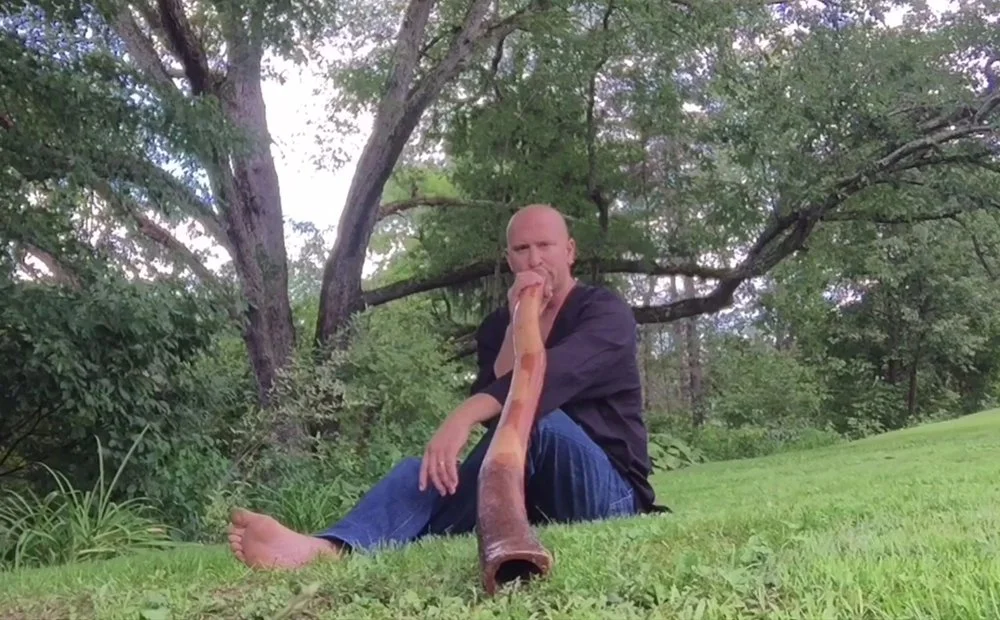
Within the first month or so of playing the didgeridoo at all, I was playing publicly. What started in blues and jazz environments eventually expanded into electronic music scenes across New Jersey, New York, and up through Portland, Maine. I loved the interplay. I loved listening as much as sounding.
When Sound Became Something Else
While I was playing in nightclubs, I was also working a trades job. I had gone from designing clothing to working as a foreman for a commercial painting company. Somewhere along the way, I felt profoundly lost.
One day, a guy working for me mentioned seeing a VH1 segment about Leonardo DiCaprio hiring a didgeridoo player to come to his house once a week and play over him while he lay on a mat by a pool. I brushed it off and told him to get back to work.
The next day, standing in the exact same spot—hanging sheetrock one day, mudding it the next—he told me the same story again. That time, something landed. I remember thinking, Okay. I get it.
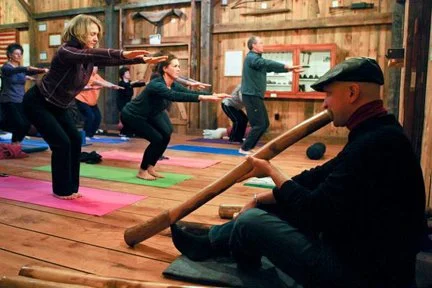
That night, in November of 2003, I went home and started researching didgeridoo sound therapy, sound healing, and anything related to sound and meditation. There wasn’t much information available at the time, so I experimented. I paid attention. I watched how people responded. By February of 2004, I had developed a basic framework for what a didgeridoo sound therapy session could be.
From the very beginning, I was clear about what I was not doing. I wasn’t healing people. I wasn’t claiming authority or special powers. My spirituality has always been deeply shamanic in nature, but one of the most important teachings I ever received was this: a shaman can only heal himself. A shaman’s greatest skill is the ability to help someone remember how to heal themselves. That distinction has guided my work ever since.
A Note on the Didgeridoo Itself
The didgeridoo is an Aboriginal Australian instrument and one of the oldest known musical instruments still in use—estimated to be tens of thousands of years old. Different Aboriginal nations have different names for it, different creation stories, and different relationships to the instrument through their Dreamtime traditions.
What I do is not Aboriginal tradition. That’s important to say clearly. I have deep reverence and respect for Aboriginal cultures, but I am not Aboriginal, and I am not attempting to play Aboriginal music or ceremony. I play with Western music. I play meditatively. I do my own work, in my own way, while honoring where the instrument comes from.
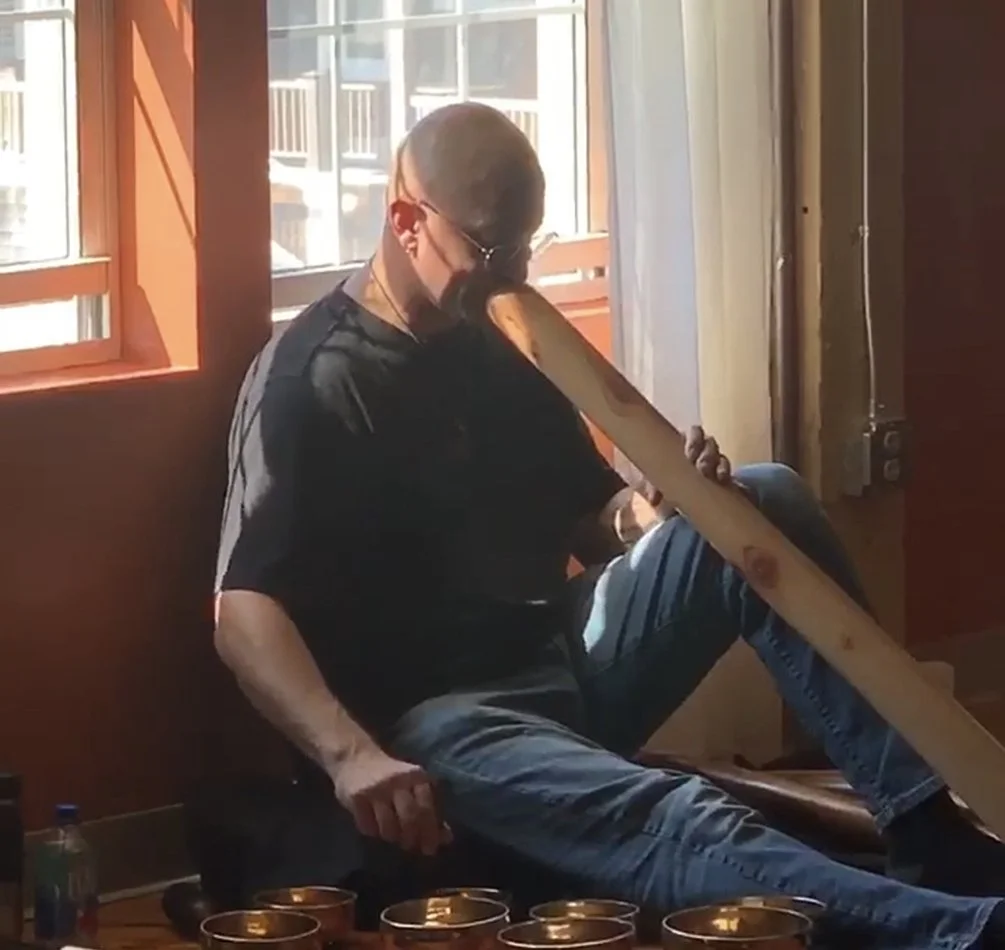
From a technical standpoint, the didgeridoo is a wind instrument—more specifically, an aerophone. Sound is created by vibrating the lips and shaping airflow through the instrument, resonating air through a hollow tube. It is physical. It is acoustic. It is grounded.
What the Sound Means to Me—and to Others
Something about the sound of the didgeridoo speaks directly to the core of my being. I can go days, weeks, even months without playing, and when I hear it, it still feels like the first time. When I pick it up, I can play as if I never stopped. It isn’t something I do—it’s something I return to.
For my own healing journey, the instrument gave me a center. A place where things felt complete and balanced. When I play, it feels like I’m doing something good—for myself first and foremost. That has never changed.
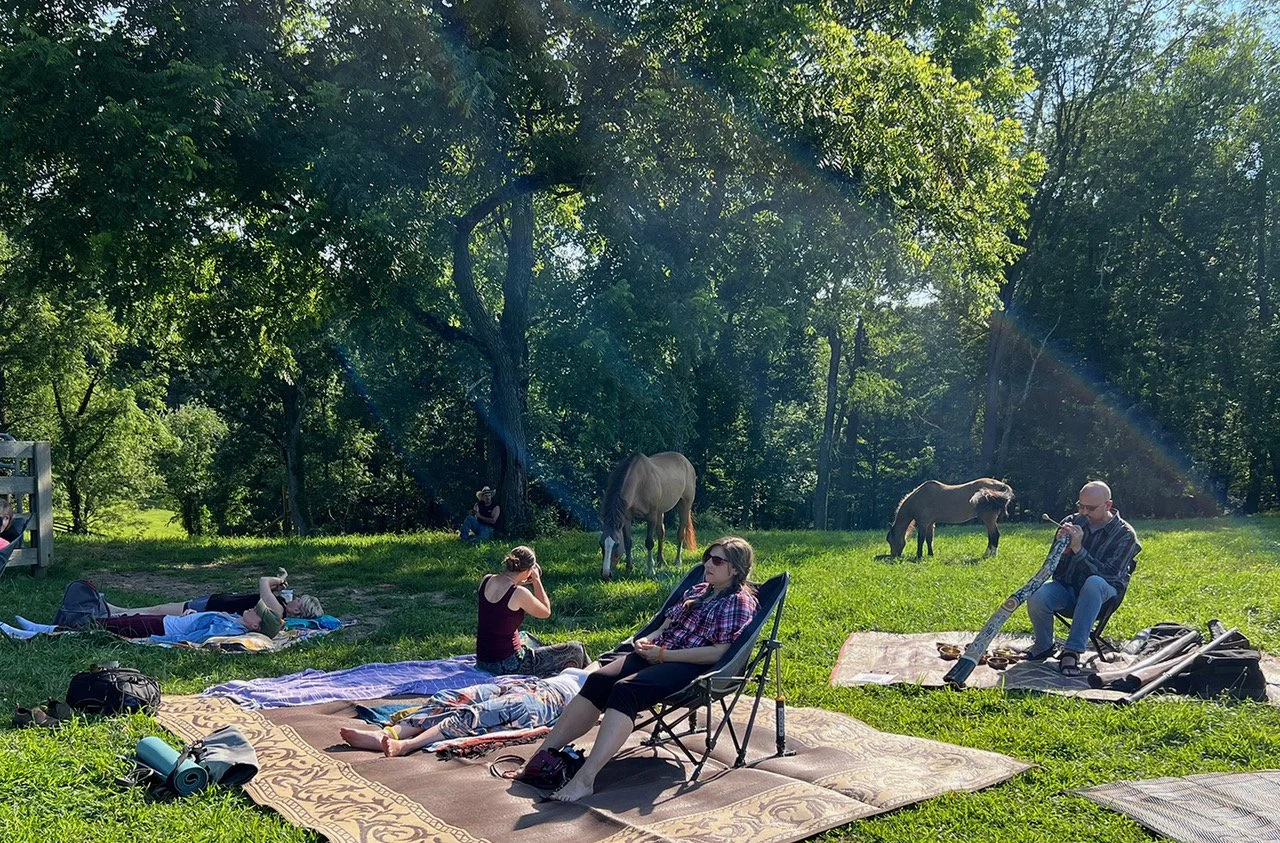
What has been a true gift is witnessing how others respond. Over the years, people all over the world have found grounding, stillness, insight, and depth through the sounds I create with a hollow stick. I don’t take that lightly. I don’t take it for granted.
Playing Alone vs. Playing Together
I’ve led solo meditations and individual sessions for over twenty years, and I value that work deeply. Solo didgeridoo practice is focused, intimate, and effective.
What changes when I play with another practitioner—especially someone like Wyatt working with gongs—is the dimension of relationship. Collaboration introduces conversation. It introduces listening. It allows sound to become architecture rather than a single line.
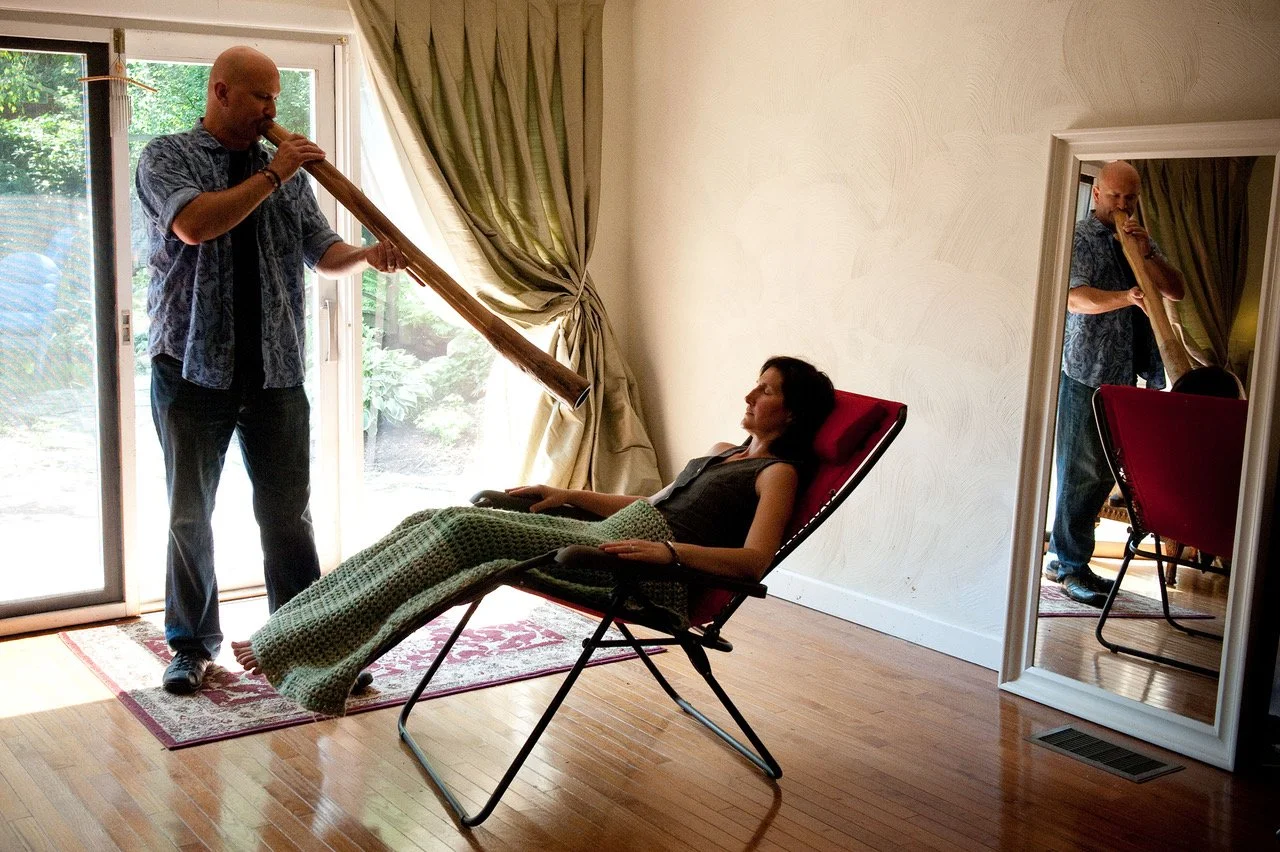
When the didgeridoo and gongs are played together, we’re weaving sound. Using music theory, harmonic relationships, and energetic awareness, we create layered sonic landscapes—textures and overtones that simply can’t exist in the same way with a single instrument. The gongs provide vast harmonic fields; the didgeridoo offers breath, pulse, and grounding. Together, they create an immersive environment with tremendous depth.
As a performer, that collaboration gives me space to explore and respond. As a participant, it offers an experience that is rich, expansive, and deeply engaging.
What to Expect
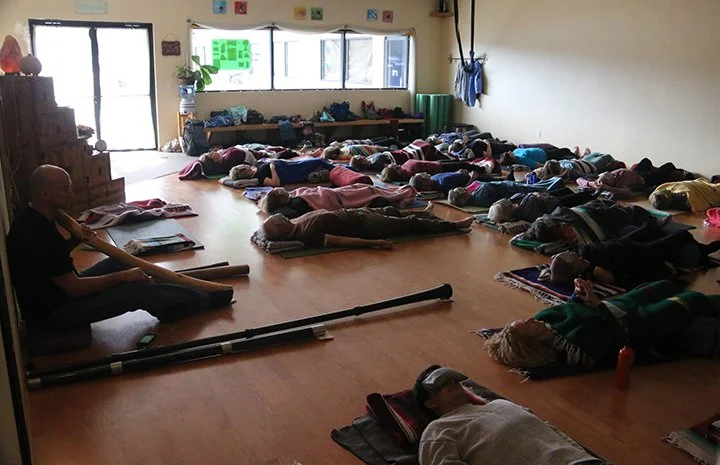
When you come to a session with Wyatt and me, you can expect a carefully held space—one grounded in presence, intention, and respect. This isn’t about performance. It’s about experience. It’s an invitation to listen, to feel, and to discover what sound makes possible for you.
For me, that’s the heart of the work. Sound as a guide. Sound as relationship. Sound as a reminder of something we already know how to do.
This way of working with sound continues through the sessions and educational offerings at Rooted in Sound. Whether through shared sound experiences or longer-form study, the focus remains on listening, relationship, and presence.
For those who feel drawn to explore sound more deeply, Rooted in Sound offers a place to learn, practice, and grow over time.