

I’m Exhausted and Unfulfilled. What Now?

A woman sits quietly by a window at dusk, resting her head on her hand and gazing outward with a tired expression
When Functioning Isn’t the Same as Thriving
You may be doing everything “right.” You go to work. You handle responsibilities. You show up for family. You pay the bills. From the outside, your life appears stable. Yet internally, something feels off. You feel drained, disconnected, or quietly dissatisfied. There may not be a dramatic crisis. There may not be a visible breakdown. But there is a persistent sense that the life you are living is not fully aligned with who you are.
Exhaustion and unfulfillment rarely come from laziness or lack of effort. They usually come from misalignment. When your energy is consistently poured into areas that do not nourish you, depletion becomes inevitable. The real question is not “What’s wrong with me?” The real question is “Where am I out of alignment?”

A woman sits with her head resting on her hand while speaking to a practitioner who is taking notes. Her expression shows stress and emotional fatigue.
Why Traditional Life Coaching Often Misses the Mark
The term “life coaching” has become widely used, and not always with depth or training behind it. Many approaches focus on productivity, goal tracking, or surface-level mindset shifts. While these tools have value, they often skip the deeper work of identity, balance, and nervous system regulation.
Transformational coaching is different. It is not about telling you what to do. It is not about prescribing a perfect routine. It is about helping you access your own internal clarity. The assumption is simple: you already know more than you think you do. You need structured reflection, honest questioning, and consistent support to uncover it.
At Rooted In Sound, coaching begins with the understanding that transformation is not forced. It emerges when your life becomes more balanced and internally coherent.
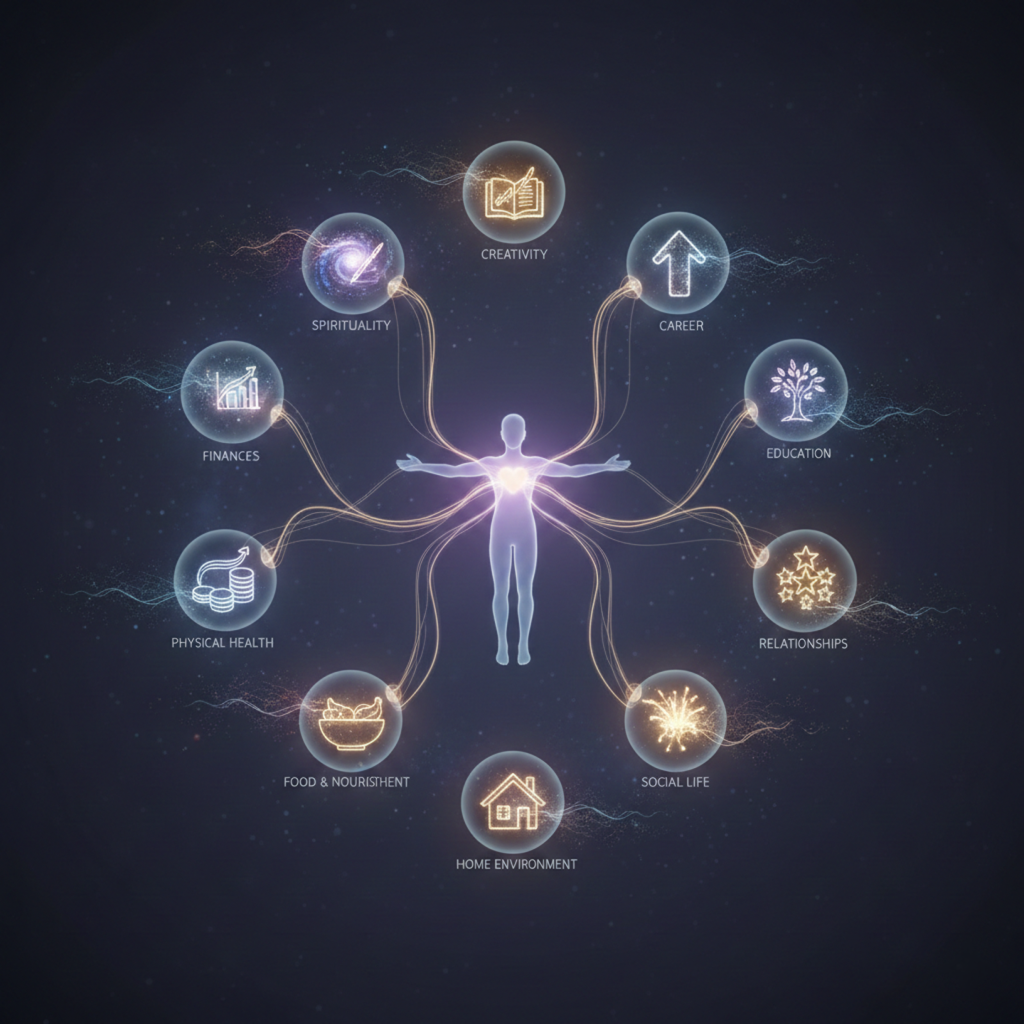
A visual diagram displays interconnected areas of life including physical health, food and nourishment, home environment, social life, and relationships surrounding the human body.
The 12 Areas That Reveal Where Energy Is Leaking
Rather than starting with a single problem, transformational coaching begins by examining the full picture of your life. Clients assess twelve core areas: spirituality, creativity, career, education, finances, physical health, food and nourishment, home environment, relationships, social life, joy, and personal growth.
This holistic view often reveals that the presenting problem is not the root issue. Someone who wants to lose weight may discover that their career drains them to the point of emotional exhaustion. Someone struggling with motivation may uncover relational stress that occupies most of their mental energy. When imbalance is identified and addressed, behavior begins to shift naturally.
Balance does not mean perfection. It means your energy is not chronically pulled in opposing directions. When these areas begin to stabilize, many goals that once felt impossible begin to feel attainable.

A stylized illustration shows a tired man sitting at a computer with his head resting in his hand. Papers and dim lighting suggest work overload and chronic stress.
Career Misalignment and Quiet Burnout
One of the most common themes in coaching is career dissatisfaction. Many individuals entered their profession due to family expectations, financial pressure, or early decisions that no longer reflect who they have become. Others are trapped in work environments that are toxic or emotionally depleting.
This misalignment does not always show up as dramatic burnout. It often appears as low-grade fatigue, irritability, or a subtle sense of meaninglessness. When career alignment is addressed, clients frequently experience renewed energy that spills into other areas of life. Motivation returns. Creativity returns. Even physical health can improve when chronic work stress decreases.

Couple sitting apart on a couch with emotional distance between them, representing relationship stress, emotional disconnection, and the need for nervous system healing support at Rooted In Sound.
Relationship Strain, Grief, and Emotional Disconnection
Relationships are another major source of pain. Clients come in navigating divorce, unresolved conflict, emotional distance in marriage, or profound grief after loss. Some feel unseen or unheard in long-term partnerships. Others struggle with boundaries in family systems that feel intrusive or controlling.
Coaching provides space to examine patterns without judgment. It allows individuals to clarify what they need, articulate boundaries, and communicate more effectively. In cases of grief, coaching does not attempt to erase pain. It supports integration. It helps individuals find connection and meaning even in the presence of loss.
Transformation in relationships often begins with self-awareness. When you understand your own needs and emotional patterns, you interact differently. That shift alone can change the relational dynamic.

Wyatt siting with two participants in a calm studio setting, holding a clipboard while singing bowls rest on a table between them. The small group setting reflects sound therapy, guided wellness coaching, and nervous system regulation offered at Rooted In Sound.
Coaching During Serious Illness
Some clients seek support while navigating cancer or chronic illness. In these situations, coaching does not replace medical treatment. It complements it. Physicians often have limited time. The emotional and psychological aspects of illness are frequently under-addressed.
Transformational coaching offers a space to process fear, repair strained relationships, reduce stress, and reconnect with a sense of agency. One client with advanced cancer used coaching to rebuild connection with her children and reconcile with her parents before she passed. Although her physical outcome did not change, her emotional and relational world transformed significantly.
Another client undergoing treatment for stage four ovarian cancer integrated Coaching and Sound Reiki alongside conventional care. She reported substantial physical improvement while also experiencing greater emotional stability. Coaching does not claim to cure illness. It supports the whole person during an extraordinarily difficult chapter.
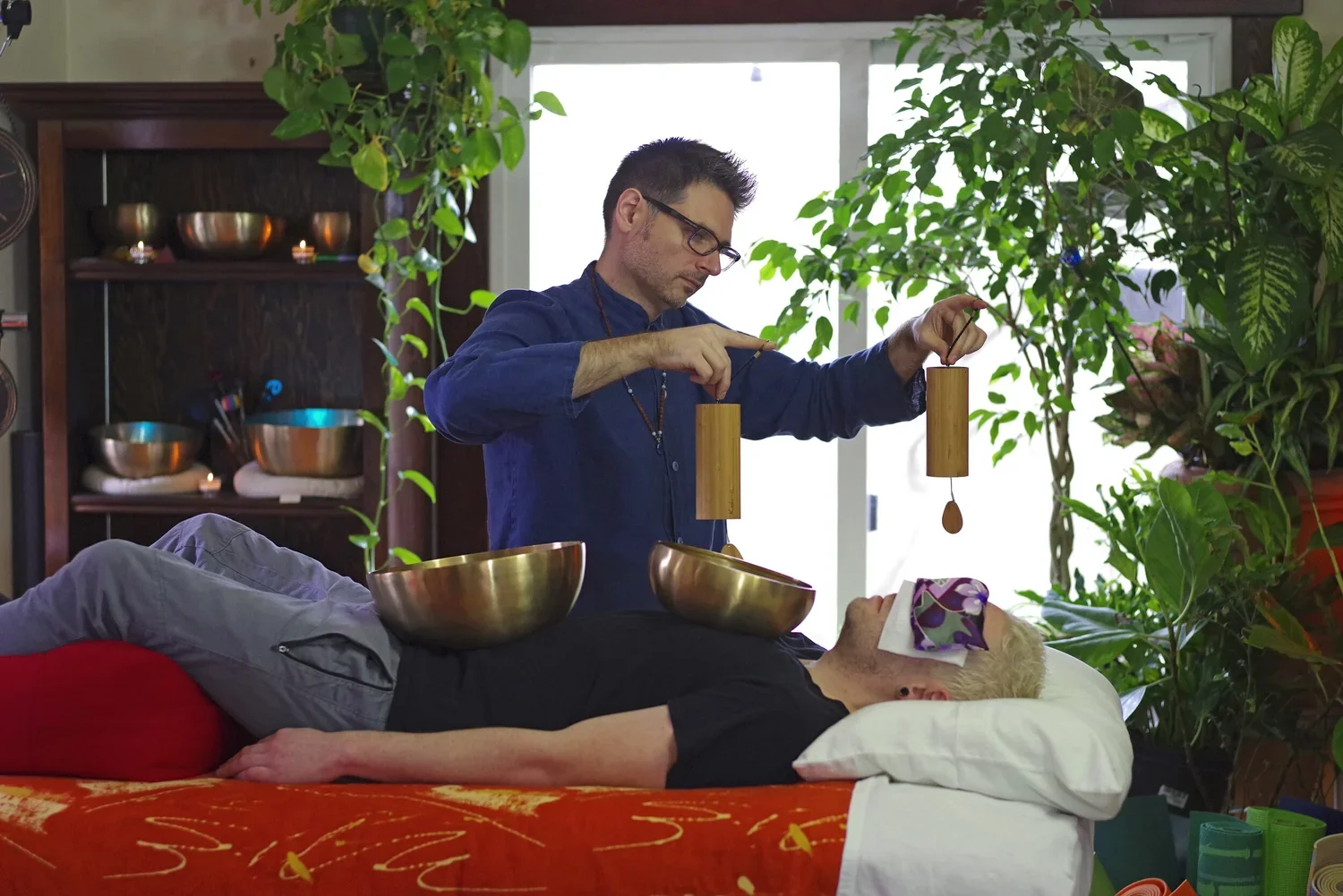
Wyatt performing a sound therapy session with Himalayan singing bowls and chimes, supporting nervous system regulation and deep relaxation at Rooted In Sound.
Integrating Sound Therapy for Nervous System Regulation
A defining feature of coaching at Rooted In Sound is the integration of sound therapy. Sessions typically include structured coaching followed by a dedicated sound experience. This pairing is intentional.
Insight alone does not guarantee change. The nervous system must feel safe enough to integrate new perspectives. Sound therapy supports deep relaxation and helps release accumulated stress. Clients often leave sessions feeling grounded rather than activated.
For individuals who are not seeking full coaching, sound therapy is also available as a standalone support service. Many high-performing professionals use it weekly to recharge and regulate their stress response. You can explore these services here:
https://www.rootedinsound.com/services

Wellness coach reviewing a personalized recovery plan with a client, supporting burnout recovery, nervous system regulation, and holistic healing.
The Importance of Commitment and Time
Sustainable change rarely occurs in a single breakthrough session. Most clients are encouraged to commit to approximately six months of consistent work. This is not a financial contract; it is a commitment to oneself. Behavioral patterns, belief systems, and relational dynamics take time to shift.
Some clients complete a cycle of coaching and move forward independently. Others return when new life challenges arise. Many transition into periodic sound therapy sessions as maintenance after achieving their primary goals. Transformation is not a one-time event. It is a process of ongoing alignment

Couple receiving relationship coaching support, representing emotional healing, communication skills, and nervous system regulation.
Recovery and Intimacy Coaching
Coaching also extends into addiction recovery and intimacy development. Recovery coaching offers an additional layer of support alongside traditional recovery programs. It focuses on accountability, identity rebuilding, and navigating triggers in daily life.
Intimacy coaching addresses both emotional and physical connection. Many individuals and couples struggle not because love is absent, but because communication, vulnerability, or pacing is misaligned. Intimacy involves feeling seen and understood. It requires presence, empathy, and the willingness to grow together. Coaching provides structure for rebuilding that connection.

Wyatt providing wellness coaching support in a private session, helping clients recover from burnout and regulate the nervous system at Rooted In Sound.
When You’re Ready for Change
If you are exhausted, unfulfilled, or quietly questioning the direction of your life, the answer is not more pressure. It is clarity. It is balance. It is structured support that helps you access your own wisdom and make sustainable shifts.
Transformational coaching at Rooted In Sound is designed for individuals navigating career dissatisfaction, relationship strain, grief, chronic stress, serious illness, recovery, or a desire for deeper connection. It integrates conversation and nervous system regulation to create lasting change.
To explore coaching options, visit:
https://www.rootedinsound.com/coaching
To learn more about sound therapy services, visit:
https://www.rootedinsound.com/services
If you are interested in professional training in this integrative approach, explore the Rooted In Sound Academy here:
https://www.rootedinsound.com/academy
You do not have to navigate this chapter alone. The first step is often a simple, honest question: What would it look like to feel aligned again?